

How to Stop Cyber Harassment and Online Blackmail - Fast
How to Stop Cyber Harassment and Online Blackmail - Fast

Submitted by Dennis Faas on Thu, 08/21/2025 - 14:30
Infopackets Reader Sam J. writes:
"Dear Dennis,
I just saw your article on how to stop online harassment - thanks for that. My teenage son got caught up in an online sextortion scam. He thought he was talking to a girl his age on Instagram, but it turned out to be a scammer who tricked him into sharing private photos. He already sent the blackmailers $500 in Steam cards. Now, they're threatening to send those images to his Instagram followers. He's terrified, ashamed, and deeply depressed. As a father, I feel completely helpless. How can I stop cyber harassment and online blackmail in order to protect my son? Please help!"
My response:
If you or your child is in this situation - you're not alone.
Since 2019, I've worked with countless victims and families struggling with cyber harassment (also known as online blackmail or sextortion). The Internet has made it easier than ever for criminals to manipulate and extort young people, and teenagers are particularly vulnerable. But you don't have to face this alone - I can help you fight back.
Need help right now? I've worked on over 1,000+ sextortion cases and know how to prevent your exposure and shut the blackmailers down. Contact me here for a free 15-minute phone call consultation - I'm happy to answer your questions. When you contact me, you will also receive two free reports that contain invaluable information: Five Strategies to Stall Blackmail Scammers and Not Pay Anything and Sextortion Survival Guide - Five Critical Mistakes to Avoid and What to Do Instead. These invaluable guides contain proven strategies to help you take control of the situation before it escalates.
In this article, I take a deep dive to explain the following:
- How to Fight Cyber Harassment and Online Blackmail
- When Cyber Harassment Turns into Blackmail
- Why Reporting Cyber Harassment Won't Work
- Cyber Harassment and Online Blackmail - Myths
- Fighting Cyber Harassment - FAQs
- How to Stop Cyber Harassment and Online Blackmail
- Final Thoughts
If you have time, keep on reading. If you are being barraged by cyber harassers / blackmailers and need help now, contact me here and we can discuss this together.
How to Fight Cyber Harassment and Online Blackmail
Here is the hard truth about fighting cyber harassment and online blackmail:
Based on my own personal experience (having worked on over 1,000+ cases since 2019), I can tell you that most online harassers operate anonymously and are overseas - even if they appear to be local, or because the perpetrator has an area code similar to yours. Often these gangs are located in Africa, Philippines, Morocco and India, making them difficult to track and prosecute. The cyber harassers hide behind VPNs, use fake profiles, and disposable phone numbers. They get these phone numbers using apps on their phone, such as TextNow and Hush (as an example).
Many cyber harassment blackmail gangs make millions of dollars a month exploiting their victims. The gangs are often unsophisticated and use prerecorded videos of women in order to lure male victims into exposing themselves. Some of the more savvy gangs pay for and use live models - some will even call you on the phone for video chat to make it seem even more real. In any case, victims often feel powerless because traditional solutions like blocking and reporting a blackmailer does little to nothing to stop these persistent attackers.
That's because when you start talking to blackmailers, they immediately start collecting as much information about you as possible (usually from Facebook and Instagram), which contains a list of your contacts. Once they have this data, they store it on their local machines. If you decide to delete your account in order to run away from the situation, it won't stop them from potentially making contact to friends, family and followers because they still have a copy of your contacts. Even if you don't have social media, there are ways to get information about you online either using search engines or paid services like BeenVerified.
To escape this mess, you need a proven plan that has been battle-tested for years - I can help (contact me here).
When Cyber Harassment Turns into Blackmail
Sextortionists use psychological warfare to break down their victims.
Here are some examples based on cases I've worked on:
- Some may make you report back every so often whenever they say "Hello" to ensure compliance. If you don't respond, the blackmailers will escalate their threats. African blackmail scammers do this often, especially when they put you on a "payment plan" that never actually ends.
- Other cyber harassment blackmailers will spread false rumors using fake accounts, then take snapshots and send them to you as proof they are carrying out their threats. Some may impersonate you or people you know to achieve the same result or to mess with your mind. Their goal is to make the victim feel trapped and helpless.
- Most sextortion scammers follow a script - but that script changes based on which blackmail gang you're dealing with. I have plenty of experience with this.
In general, blackmail scammers initially engage their victims through social media, dating apps, or messaging platforms, pretending to be someone they're not. Once trust is built, they encourage the victim to share explicit content. As soon as they have compromising material, the threats begin. Victims often end up looking for advice on what to do if someone is blackmailing you on Google Chat or what to do if you're being blackmailed on Snapchat after meeting someone they thought was genuine.
Why Reporting Cyber Harassment Won't Work
Many victims assume that reporting the cyber harassment to social media platforms or the police will solve the problem. Based on my experience, this rarely ever works.
Here's why -
- Scammers create multiple fake accounts on the social media platforms. Even if one account is taken down, another appears within minutes and the blackmailers continue on taunting their victims. Most of the time, the blackmailers are overseas and work in groups. They are good at what they do and can easily counter your every move - unless you know ahead of time what those moves are and have a plan (which is also how and why I can help).
- Law enforcement agencies are often overwhelmed and are ill-equipped to handle sextortion effectively. Even so, the blackmailers usually threaten exposure imminently and this doesn't give victims a chance to investigate alternatives. On top of that, most blackmailers are anonymous and overseas, which means your local law enforcement can't help.
That's why having a strategic plan is essential - you need to outmaneuver the scammers, not just react to them - contact me for help. Let's talk about it.
Cyber Harassment and Online Blackmail - Myths
One of the biggest misconceptions is that paying the blackmailer will make them go away - even if it's to temporarily "get them off your back".
Unfortunately, it does the exact opposite.
In 100% of the cases I've worked on where the victim has paid, the scammer has returned asking for more. They may not do it right away - possibly because the cash hasn't cleared (because it was wired), or maybe because the scammer is busy scamming other victims at the same time as you - but they always return asking for more.
In many cases, cyber harassers share the victim's details with other blackmailers (often within the group) who will then also make demands. In fact, it is common for victims to tell me that once the demands began, they received requests from multiple phone numbers asking for money to be sent to different locations - as if they were dealing with a disorganized group of cyber criminals competing with each other. The only reason they would be doing this is because the scammers are fighting over each other for your money (and because the group is disorganized).
Another common myth is that simply ignoring the scammer will make them stop. Be careful here - this can easily backfire.
The truth is that ignoring a blackmailer only works when done strategically.
Here's why -
If a victim suddenly disappears, scammers often escalate by reaching out to family and friends. They do this to pressure the victim back into communication for another round of 'negotiations' - refer to this Facebook blackmail screenshot as an example. Quite often, scammers will send you screenshots of conversations they are having with friends and family so that you know their threats are real.
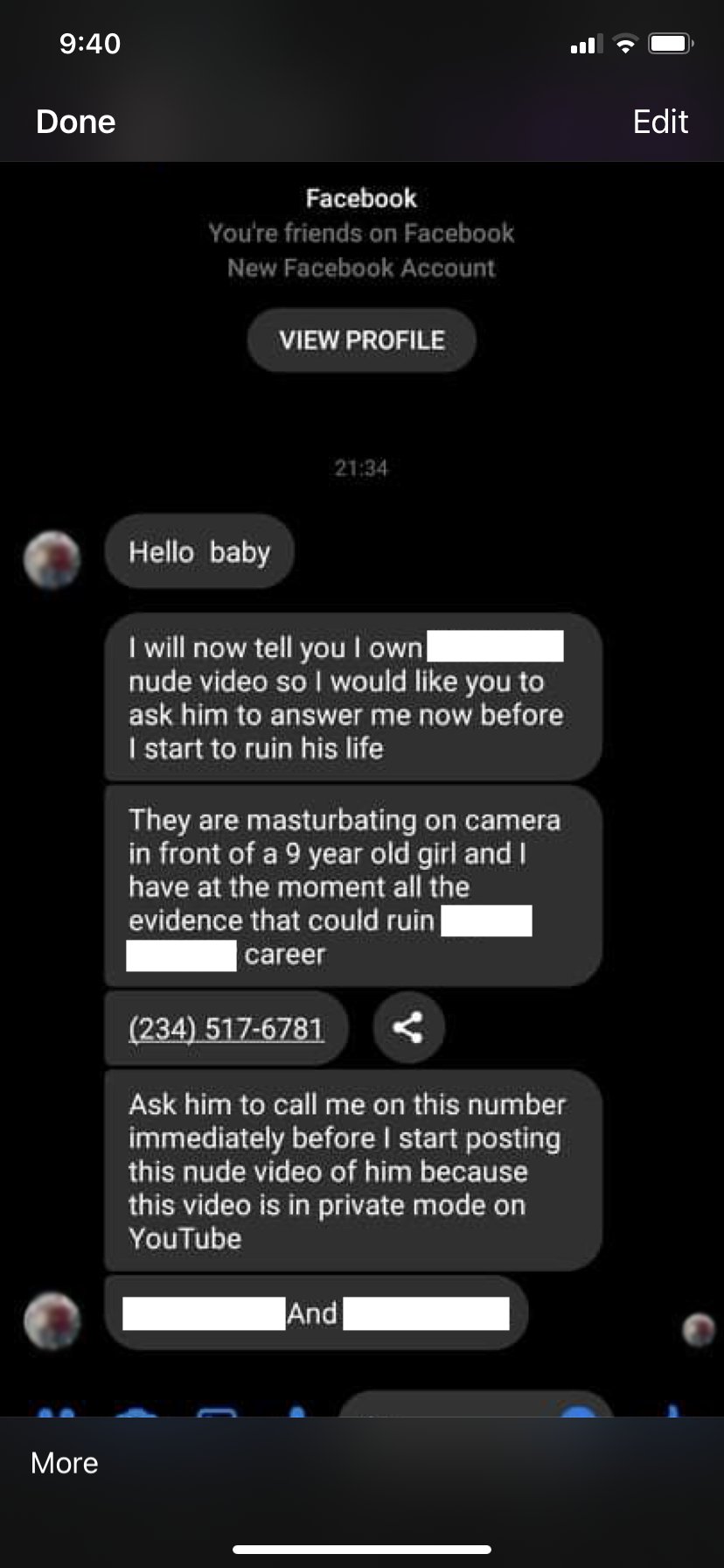
One of the most common questions I get is about Instagram blackmail, since it is one of the top platforms where scammers target victims. The setup usually starts with a fake profile, followed by flattery and requests for private photos or video chats. If you ever find yourself being blackmailed on Instagram, it is critical that you know how to respond before the threats escalate.
Fighting Cyber Harassment - FAQs
Do Blackmailers Ever Stop?
All blackmailers go away after a certain point, but not when you've had recent interaction with them and you're "hot on their radar," and because they work in groups. Eventually they will move on when they realize you're not worth the time or after they've decide it's time to expose you. If you don't want that to happen, consider contacting me for assistance.
Should I Ignore a Blackmailer?
You can, but I don't recommend it especially if you have anything to lose. It is better to outmaneuver a blackmail scammer with a plan, rather than to leave things up to chance. To successfully stop cyber harassment, you need to know how and when to respond for the best outcome. I can help.
What can The Police do about Blackmail?
Law enforcement is often ineffective in dealing with online harassment unless you know 100% who the person is that is bullying / blackmailing you, they live in your country (usually near you, but not always), and you can prove it's them. The same goes for a lawyer. A cease and desist letter is NOT going to help you especially if the blackmailer is in another country. They don't care what they're doing is illegal and will likely escalate their threats if you hand them a cease and desist letter. I know this is true because one client that hired another company did exactly this (previous to hiring me) and the threats escalated.
If you're dealing with an anonymous blackmailer, you need a clear plan with strategies, contingencies, and preparation for worst-case scenarios. Blackmail gangs often act in unpredictable ways that can cause serious damage - and I can prove it by showing you evidence I've collected from real cases I've handled. This is exactly the type of preparation that I'm offering. I've already helped thousands, my methods work immediately, and cost far less than legal fees. I can help you too - contact me here.
On that note, not every blackmail case starts online - some begin after meeting someone while traveling. For example, here's what to do if you've been sextorted in Thailand.
Should I Delete my Facebook or Instagram?
Some steps can help to limit what the blackmailers can do, and it's always advisable to make your account private instead of deleting it entirely because (a) at some point this will come to pass and you may still want to be in contact with friends and family on social media, and (b) during this difficult time, you may need to reach out to friends and family to explain things. If you aren't sure what to say, I can help.
Keep in mind that not all threats begin on your existing accounts. Many cases start on dating apps, where scammers quickly move victims over to messaging platforms. A common example is Facebook Dating sextortion on WhatsApp once criminals gain leverage.
The fact is: once the cyber harassers know who you are or have access to your social media, they make copies of it and store that data on their machines. So, deleting your Facebook or Instagram won't help whatsoever - in fact, it may make it worse because the blackmailers typically escalate their threats if they think you're about to run away. This is especially true if they see your social media has been deleted.
Always remember: the people behind cyber harassment are 10+ steps ahead because they work in organized crime rings and blackmail victims all day long. That said, I can show you how to make yourself or your child a much harder target and reduce the chances of future problems. I've handled this scam with over 1,000+ victims already, so I know exactly how to respond when it happens.
Related:
Should I Pay for Online Reputation Management?
I don't recommend this because there is no 100% sure-fire way to scan the entire Internet and guarantee everything is going to get removed. If anything, services like these are automated and are only good at finding things after it's been sitting on the Internet for quite some time (long enough to be indexed by a search engine).
The fact is: most of the time, blackmailers act upon their threats by contacting friends and family directly through social media (or by direct text message, if they can get this info). Other times, they will upload the material to adult sites, label it with your name and number, then share those links with people you know as a way to expose you. If you want your video removed, you have to contact the webmaster directly that owns the website and make a request. Most of the time, however, these sites are difficult to contact on purpose. In the end, it is up to the webmaster to comply, but the process can be expedited if you make the request properly. This is part of the service I offer and I don't charge extra for it.
Being Blackmailed with Pictures - What to Do?
If you or your child met someone online and pictures were sent (or a video was recorded) and the scammers are asking for money to stay silent, then this type of cyber extortion is in fact sextortion. Regardless, paying will only make it worse. Stopping cyber harassment of this type requires a plan to eliminate threats and avoid exposure; this includes strategies and contingencies and plan for worst-case scenarios. You can also read some of my articles on the subject to learn more:
- Will a Blackmailer Follow Through?
- How do You Deal with Sextortion? (and what not to do)
- How Long do Romance Scams usually Last?
- What to do if Someone is Blackmailing Me on Facebook
How to Stop Cyber Harassment and Online Blackmail
If you're already being targeted with cyber harassment and online blackmail and want to know how to stop it, you probably don't have time for generic advice such as "lock down your social media" and "secure your digital footprint". You need proven strategies that not only stop the harassment, but minimize risk and prevent exposure.
That's where I can help.
If you are being blackmailed or harassed online, you do not have time to waste on generic advice. Every second counts, and one wrong move could make your situation ten times worse. Using proven strategies that have helped thousands of victims, here's why reaching out to me right now is worth your time:
1. Stall the Scammer - But Only If You Do It Right
One of the best things you can do in order to stop cyber harassment and online blackmail (as it pertains to sextortion) is to buy yourself time without making things worse. This will allow you think about your options more clearly. My free report on "Five Strategies to Stall Blackmail Scammers and Not Pay Anything" explains how to do this properly, including:
- Keeping the scammer engaged without paying. I teach specific deception tactics that make scammers believe you are cooperating, giving you critical time to implement a real plan. I argue that engaging with the scammer with minimal talk can actually calm them down without escalating their threats, while the opposite is true. That said, you need to be strategic with your communication, or the blackmailers will corner you and force you to pay. If you're not sure how to proceed, contact me for help.
- Using excuses that work. Blackmailers will not just accept any excuse - they are trained to counter your objections and because they do it all day, every day. I know what works and what doesn't because I've helped more than 1,000 victims directly and have seen firsthand the mistakes that can make things worse.
- Avoiding the "block and run" mistake. If you think simply blocking the scammer will end it, you are wrong. I will show you how to disengage safely, minimizing your risk of exposure.
The number one mistake victims make is acting out of fear. Fear is illogical. What you need is a plan, and that is where I can help.
2. Absolutely Do NOT Do This
My second free report, "Sextortion Survival Guide - Five Critical Mistakes to Avoid and What to Do Instead," lays out critical actions that could mean the difference between getting out safely or making things worse. Here is a summary:
- DO NOT pay the blackmailer. Paying guarantees one thing: they will come back for more. I explain why and what to do instead.
- DO NOT shut down your social media. This does the opposite - it usually triggers escalation because the scammers think you're running away and won't pay them.
- DO NOT give them more information. Scammers manipulate victims into providing details that increase their leverage. If you are already caught, I will teach you how to cut them off at the source and with minimal risk of exposure.
Instead, do this:
- DO use stalling tactics. I give you proven phrases and tactics that keep you in control without triggering escalation. In many cases, this makes the difference between getting exposed and walking away safely.
For example, whenever a victim hires me for assistance with online blackmail, I often recommend using a fake payment strategy that stops the scam in its tracks without actually spending a dime. My fake payment strategy works because it (a) calms the blackmailers down knowing that you tried to pay them, and (b) when the payments keep failing, this will ultimately frustrate the scammers enough that they will leave you alone and move onto another victim.
A word of warning, however - if you attempt this on your own (without hiring me first), be advised that scammers will definitely demand proof that your payment failed. If you can't provide it instantly, they'll hit back with more threats and may escalate to exposure. My fake payment strategy, however, gives you immediate proof every single time - removing their leverage.
- DO reach out for expert help. In many cases, fighting cyber harassment means that you are most likely dealing with professional criminals who run these scams in organized groups. They have tricks and traps that you will not see coming - but I know what they are because I've worked on over 1,000+ cases since 2019. I can help you, too. Contact me here.
3. You Need a Plan - Not Panic
The fact is: you have a 50% chance of being exposed. Some scammers fake their threats, some follow through, and some go the extra mile. Doing nothing about it can easily backfire. The key is understanding who you are dealing with and implementing the right response strategy.
- I know how to prevent exposure. If you are at risk, I can show you how to cut the blackmailers off before they reach your friends, family, or employer.
- I prepare you for multiple worst-case scenarios. If exposure happens, I provide damage control strategies that can neutralize the scammer's threats.
- I give you a permanent solution. My clients do not have to keep coming back to me. Once we handle the situation, you will know exactly what to do if anything happens, should the blackmailers reappear at some point in the future. All info is sent to you by email for later reading if needed. There is 100% transparency.
Final Thoughts
When it comes to fighting cyber harassment and online blackmail, you have two choices:
- Do nothing and hope the scammer goes away. Sometimes this works and sometimes it doesn't. To make this decision as simple as possible: if you have nothing to lose, block them and be done with it. On the other hand, if you are worried about your reputation and don't want to take any risk, consider Option #2 below.
- Contact me now for your free 15 minute phone call to assess your situation. When you reach out to me via our contact form, you'll also receive two free reports under no obligation: Five Strategies to Stall Blackmail Scammers and Not Pay Anything and Sextortion Survival Guide - Five Critical Mistakes to Avoid and What to Do Instead.
Here's why my approach to stopping cyber harassment and blackmail is different from anything else you'll find online:
- I provide direct, 1-on-1 help - not fake promises about catching scammers with a tracking link or magically forcing the bad guys to delete your data. Those claims can't be proven. What you will get is an actionable plan, built from handling 1,000+ real cases, with proven strategies and backup contingencies that actually work.
- You only pay once. I don't nickel-and-dime clients for fees like other so-called companies on the Internet do, setting you up to pay for a "Phase 2" support package that costs thousands more than you already paid, all the while skipping over the fact that "Phase 1" package you paid for wasn't enough or didn't work at all.
- I am the only Better Business Bureau A+ accredited business in this sector. I have been helping people online for 24 years with an A+ rating and zero complaints.
- I give you full documentation. You will not have to keep paying me for extra help. Everything you need is in writing so you can reference it anytime.
- I have handled over 1,000+ cases successfully. My knowledge comes from real experience helping real victims.
Most cases can be resolved within 1 to 3 days - but only if you take action now. I look forward to serving you!
About the author: Dennis Faas is the CEO and owner of Infopackets.com. Since 2001, Dennis has dedicated his entire professional career helping others with technology-related issues with his unique style of writing in the form of questions-and-answers; click here to read all 2,000+ of Dennis' articles online this site. In 2014, Dennis shifted his focus to cyber crime mitigation, including technical support fraud and in 2019, online blackmail. Dennis has received many accolades during his tenure: click here to view Dennis' credentials online DennisFaas.com; click here to see Dennis' Bachelor's Degree in Computer Science (1999); click here to read an article written about Dennis by Alan Gardyne of Associate Programs (2003). And finally, click here to view a recommendation for Dennis' services from the University of Florida (dated 2006).

Rate this article:
Category:
Need Help? Ask!

My name is Dennis Faas and I am a senior systems administrator and IT technical analyst specializing in technical support and cyber crimes with over 30 years experience; I also run this website! If you need technical assistance , I can help. Click here to email me now; optionally, you can review my resume here. You can also read how I can fix your computer over the Internet (also includes user reviews).
My name is Dennis Faas and I am a senior systems administrator and IT technical analyst specializing in technical support and cyber crimes with over 30 years experience; I also run this website! If you need technical assistance , I can help. Click here to email me now; optionally, you can review my resume here. You can also read how I can fix your computer over the Internet (also includes user reviews).
We are BBB Accredited

We are BBB accredited (A+ rating), celebrating 25 years of excellence! Click to view our rating on the BBB.